
Robotic Cancer Surgery in Rajasthan: Is It Better Than Open Surgery for Your Condition?
Introduction
When a cancer diagnosis leads to a recommendation for surgery, many patients and families in Rajasthan face an unfamiliar question: What type of surgery is best for my situation? Robotic cancer surgery in Rajasthan is becoming an increasingly discussed option — but understanding what it actually means, and whether it is suitable for your condition, requires clear and honest information.
This article explains robotic surgery in simple terms, compares it with traditional open surgery, and helps you ask the right questions when consulting your oncology team.
What Is Robotic Cancer Surgery?
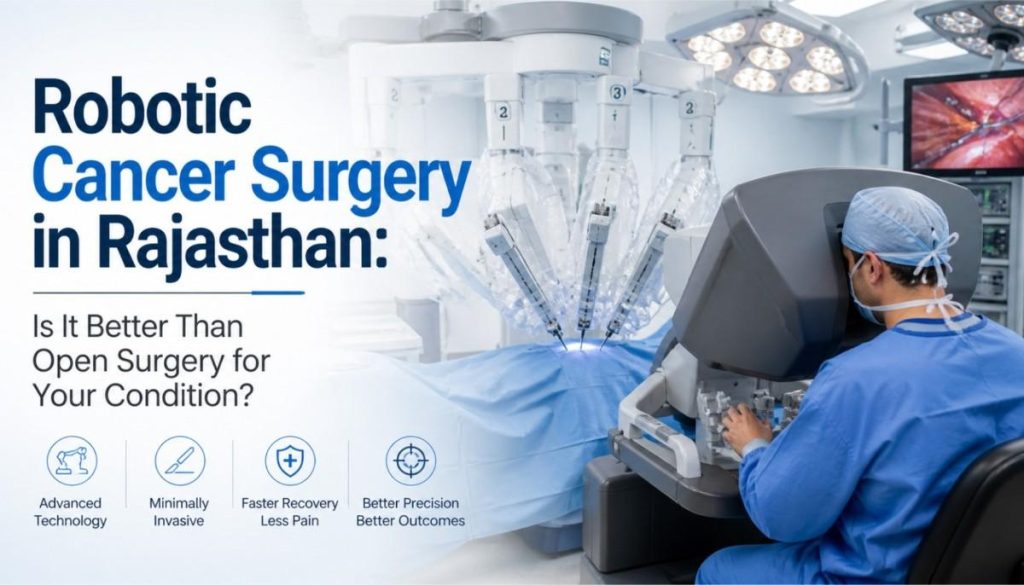
Robotic surgery is a form of minimally invasive surgery — meaning it is performed through small incisions rather than a large opening in the body. The surgeon operates using a console that controls robotic arms fitted with precise, flexible instruments and a high-definition camera.
It is important to clarify: the robot does not operate independently. The surgeon remains fully in control at all times. The robotic system simply enhances the surgeon’s precision, range of movement, and visibility in confined anatomical areas.
Robotic surgery is used for several cancer types including prostate, colorectal, gynaecological, and certain abdominal cancers, depending on the stage and location of the tumour.
Robotic Vs Open Surgery: Understanding The Difference
Open surgery involves a larger incision to directly access the tumour. It remains the standard and most appropriate approach for many cancer cases — particularly complex, advanced, or large tumours where direct access and full visibility are essential.
Robotic or minimally invasive cancer surgery, by contrast, may offer certain advantages in appropriate cases:
- Smaller incisions and reduced scarring
- Lower risk of blood loss during the procedure
- Shorter hospital stay in many cases
- Faster return to routine activities
- Reduced post-operative discomfort in suitable patients
However, robotic surgery is not universally better. The right surgical approach depends entirely on the cancer type, stage, tumour size, patient health, and the surgeon’s clinical judgement. No single technique suits every patient.
Importance Of Timely Surgical Evaluation In Rajasthan
Across Rajasthan, many patients delay seeking a surgical opinion due to limited awareness of available options or uncertainty about where to go. This delay can affect the range of surgical choices available at the time of treatment.
Early evaluation by a qualified surgical oncologist allows the team to assess whether minimally invasive techniques — including robotic surgery — are clinically appropriate for a given case, or whether open surgery would deliver the safest outcome. Patients from Jodhpur, Bikaner, Udaipur, Ajmer, and surrounding regions now have access to advanced cancer surgery in Jaipur and nearby centres, reducing the need to travel to distant cities.
Treatment Approach At Zanish Cancer Hospital
At Zanish Cancer Hospital, every surgical case is reviewed through a multidisciplinary tumour board before a procedure is recommended. This board includes surgical oncologists, medical oncologists, radiation specialists, radiologists, and pathologists — all collaborating to determine the most appropriate treatment plan.
The decision between robotic, laparoscopic, or open surgery is made based on clinical evidence, not on the basis of technology availability alone. Patient safety and oncological completeness — ensuring the cancer is adequately treated — are always the primary considerations.
Clinical Expertise & Leadership
Dr. Nishant Sanghavi, surgical oncologist at Zanish Cancer Hospital, brings specialised training in advanced laparoscopic oncosurgery alongside his MCh qualification in surgical oncology. His experience spans complex cancer surgeries across multiple sites, including gastrointestinal, breast, and head and neck cancers.
His approach reflects the hospital’s broader commitment: recommending the surgical technique that is most appropriate for the patient’s specific condition, rather than applying a one-size-fits-all approach.
The Patient Care Journey
- Consultation — Detailed review of diagnosis, imaging, and surgical history
- Surgical Assessment — Evaluation of which technique is clinically appropriate
- Pre-operative Preparation — Anaesthesia review, patient counselling, and planning
- Surgery — Performed using the safest and most effective technique for the case
- Recovery — Inpatient monitoring, pain management, and wound care
- Follow-Up — Ongoing monitoring for healing, treatment response, and recurrence
Throughout this journey, patients and families receive clear explanations and are encouraged to ask questions at every stage.
Why Patients From Rajasthan Choose Zanish Cancer Hospital
Patients across Rajasthan choose Zanish Cancer Hospital because the team provides honest guidance on treatment options — including when robotic surgery is appropriate and when it is not. This transparency builds trust, especially for patients navigating cancer care for the first time.
The hospital’s integrated care model means patients do not need to coordinate between multiple providers independently. Surgical, medical, and radiation oncology services are available under one team.
FAQs
Q1. Is robotic surgery better than open surgery for cancer?
Not always. The best surgical approach depends on your cancer type, stage, and overall health. Your surgical oncologist will recommend the technique most likely to achieve complete tumour removal safely.
Q2. What is the cost of robotic cancer surgery in Rajasthan?
Costs vary depending on the type of cancer, complexity of the procedure, and hospital facilities. It is advisable to discuss costs and insurance coverage directly with the hospital’s patient care team during consultation.
Q3. What are the benefits of robotic surgery for cancer patients in Jaipur?
In appropriate cases, robotic surgery may offer smaller incisions, reduced blood loss, shorter hospital stays, and faster recovery — but suitability must be assessed individually by a qualified surgeon.
Q4. Is robotic cancer surgery available in Rajasthan?
Yes. Advanced cancer surgery including minimally invasive techniques is available at dedicated oncology centres in Rajasthan, reducing the need for patients to travel outside the state.
Q5. How do I know if I am a candidate for robotic surgery?
A detailed consultation with a surgical oncologist, including review of your imaging and biopsy reports, is necessary to determine whether robotic surgery is appropriate for your specific case.
Conclusion
Robotic cancer surgery is a meaningful advancement in oncology — but it is one tool among many, not a universal solution. The most important step any patient in Rajasthan can take is to consult a qualified surgical oncologist early, ask informed questions, and allow a multidisciplinary team to guide the right treatment decision.
If you or a family member is exploring surgical options for cancer, consider scheduling a consultation with the oncology team at Zanish Cancer Hospital for an honest, thorough, and personalised evaluation.
The right surgical decision begins with the right conversation. Reach out today.
Other Posts
Is Robotic Surgery Safe for Older Cancer Patients?
Is Robotic Surgery Safe for Older Cancer Patients? Robotic-assisted surgery is a form of minimally invasive surgery in which the...
How Robotic Surgery Reduces Recovery Time After Cancer Treatment
Robotic Surgery Recovery Time: How It May Support Recovery After Cancer Treatment For patients undergoing cancer surgery, recovery is an...
What to Ask Before Choosing a Robotic Cancer Surgery Team
What to Ask Before Choosing a Robotic Cancer Surgery Team What Makes a Good Robotic Cancer Surgery Team? A strong...