

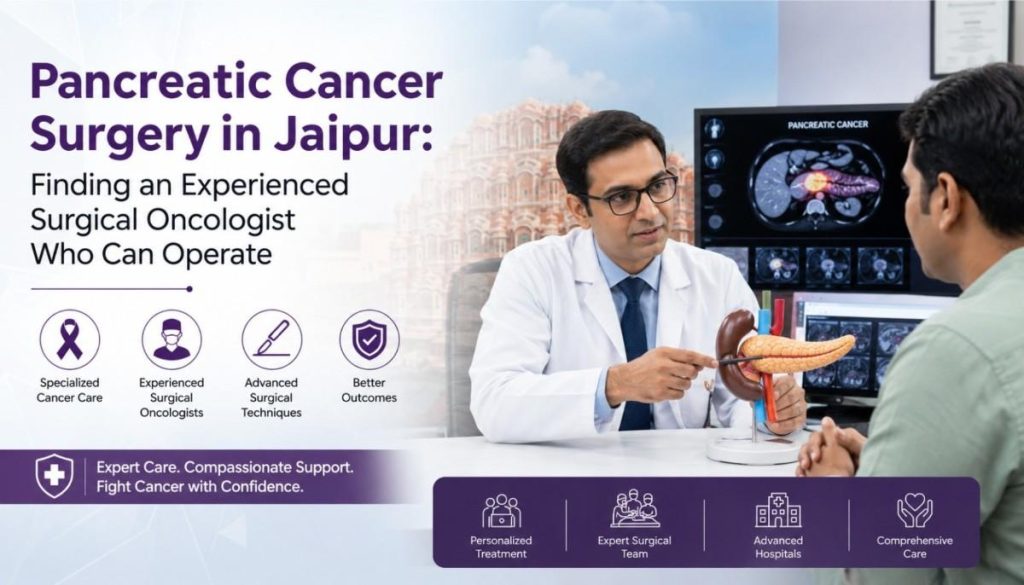
Pancreatic Cancer Surgery in Jaipur: Finding an Experienced Surgical Oncologist Who Can Operate
Introduction
When a family member is diagnosed with pancreatic cancer, the first urgent question is often: where can we find a surgeon experienced enough to operate? For patients across Rajasthan, the search for pancreatic cancer surgery in Jaipur can feel daunting — this is one of the most complex cancer surgeries in oncology, and not every hospital offers it. The good news is that experienced pancreatic oncology surgery is now accessible within Rajasthan, without the need to travel to distant cities.
Understanding Pancreatic Cancer
The pancreas is a gland located behind the stomach that plays a vital role in digestion and blood sugar regulation. Pancreatic cancer develops when malignant cells form in the tissues of the pancreas. It is known to be aggressive and is often detected at a later stage because early symptoms — mild abdominal discomfort, back pain, or subtle jaundice — are easy to overlook or attribute to other conditions.
Pancreatic cancer affects both men and women, typically presenting after the age of 50. Risk factors include smoking, diabetes, chronic pancreatitis, obesity, and a family history of the disease. While it presents significant treatment challenges, surgical intervention — when the tumour is operable — remains the most effective pathway toward long-term disease control.
Why Timely Care Matters in Rajasthan
Across Rajasthan, awareness of pancreatic cancer symptoms remains limited, leading many patients to consult specialists only after the disease has progressed. The window for surgical eligibility — where the tumour is resectable, meaning it can be surgically removed — is narrow. Once cancer spreads beyond the pancreas to major blood vessels or distant organs, surgery may no longer be appropriate.
For patients in Jaipur, Jodhpur, Udaipur, and surrounding regions, timely access to advanced pancreatic cancer treatment without travelling outside the state can make a meaningful difference — both clinically and for the family managing the care journey.
Treatment Approach at Zanish Cancer Hospital
At Zanish Cancer Hospital, pancreatic cancer is approached through a comprehensive multidisciplinary model. Before any surgical recommendation is made, the case is reviewed by a tumour board comprising surgical oncologists, medical oncologists, gastroenterologists, radiologists, and pathologists.
Surgical options for pancreatic cancer include:
Whipple Procedure (Pancreaticoduodenectomy) — The most common surgery for cancers in the head of the pancreas. It involves removal of the head of the pancreas, part of the small intestine, the gallbladder, and a portion of the bile duct. The Whipple procedure in Rajasthan requires a highly experienced surgical team and dedicated post-operative infrastructure.
Distal Pancreatectomy — Removal of the body and tail of the pancreas, sometimes along with the spleen. Performed when the tumour is located in the left portion of the pancreas.
Total Pancreatectomy — Removal of the entire pancreas. Considered in specific cases where cancer is distributed across multiple regions of the gland.
Palliative Surgery — For patients where curative surgery is not possible, palliative procedures such as biliary bypass or gastric bypass can relieve symptoms like jaundice or obstruction and improve quality of life.
Eligibility for surgery depends on tumour location, stage, involvement of blood vessels, and overall patient fitness — all carefully evaluated before a recommendation is made at the Zanish Cancer Hospital.
Clinical Expertise & Leadership
Pancreatic surgery demands exceptional technical precision and thorough pre-operative planning. At Zanish Cancer Hospital, Dr. Nishant Sanghavi, Surgical Oncologist, brings specialised experience in complex hepato-pancreato-biliary (HPB) cancer surgeries. His involvement in tumour board discussions ensures each patient’s surgical plan is evidence-based, individualised, and coordinated with medical and radiation oncology where needed.
The Patient Care Journey
Consultation: Detailed review of symptoms, imaging reports, and prior investigations.
Diagnosis: CT scan (pancreatic protocol), MRI, ERCP, endoscopic ultrasound (EUS), and biopsy to confirm diagnosis and assess resectability.
Surgery: Performed following comprehensive pre-operative optimisation, anaesthesia planning, and multidisciplinary approval.
Post-Operative Recovery: Hospital stay typically ranges from 7 to 14 days. Recovery at home takes approximately 6 to 8 weeks. Nutritional support, enzyme replacement therapy, and blood sugar monitoring are integral parts of the recovery plan.
Follow-Up: Imaging and tumour marker (CA 19-9) monitoring every 3 months for the first two years, followed by annual assessments.
Why Patients from Rajasthan Choose Zanish Cancer Hospital
Patients and families from across Rajasthan choose Zanish Cancer Hospital because the institution offers surgical expertise, honest guidance about what is and is not surgically possible, and coordinated care — all within the state. Families managing a pancreatic cancer diagnosis value transparent communication about prognosis, treatment options, and realistic expectations, which forms the foundation of care at Zanish.
FAQs
Which hospital does pancreatic cancer surgery in Jaipur?
Zanish Cancer Hospital offers specialised pancreatic cancer surgery in Rajasthan, including the Whipple procedure, performed by experienced surgical oncologists with multidisciplinary support.
Is pancreatic cancer surgery possible in Jaipur?
Yes. Complex pancreatic surgeries including the Whipple procedure are performed in Jaipur at Zanish Cancer Hospital for eligible patients whose tumours are assessed as resectable.
Who is the most experienced pancreatic cancer surgeon in Rajasthan?
Seek a surgical oncologist with specific training in hepato-pancreato-biliary (HPB) surgeries and access to a full multidisciplinary oncology team. A detailed consultation will help determine surgical eligibility.
What is the recovery time after the Whipple procedure?
Most patients remain hospitalised for 7 to 14 days. Full recovery typically takes 6 to 8 weeks, with close nutritional and medical monitoring throughout.
Can pancreatic cancer be treated without surgery?
In cases where the tumour is not operable, chemotherapy, radiation, or a combination may be used to control the disease or relieve symptoms. Your oncologist will guide the most appropriate pathway based on staging.
How do I know if my pancreatic cancer is operable?
Operability is assessed through specialised imaging (CT pancreatic protocol, MRI) and tumour board evaluation. Not all pancreatic cancers are surgically resectable — a specialist consultation is essential.
Conclusion
Pancreatic cancer surgery is among the most technically demanding procedures in oncology — but for eligible patients, it offers the most meaningful chance at disease control. If you or a loved one has been diagnosed with pancreatic cancer in Rajasthan, early specialist consultation is the most important step you can take.
The oncology team at Zanish Cancer Hospital is available to evaluate your case, explain your surgical options honestly, and guide you through every stage of the care journey with expertise and compassion.
Other Posts
Zanish Cancer Hospital vs Other Oncology Centres in Rajasthan: What Patients Are Choosing and Why
Zanish Cancer Hospital vs Other Oncology Centres in Rajasthan: What Patients Are Choosing and Why Introduction Choosing the best cancer...
Pancreatic Cancer Surgery in Jaipur: Finding an Experienced Surgical Oncologist Who Can Operate
Pancreatic Cancer Surgery in Jaipur: Finding an Experienced Surgical Oncologist Who Can Operate Introduction When a family member is diagnosed...
Cervical Cancer Surgery in Rajasthan: Which Procedure Is Right for Your Stage?
Cervical Cancer Surgery in Rajasthan: Which Procedure Is Right for Your Stage? Introduction A cervical cancer diagnosis raises immediate questions...
