
Know Robotic vs Traditional Cancer Surgery: What Patients From Rajasthan Should Know Before Deciding
Introduction
If you or a loved one have just been told that surgery is part of the cancer treatment plan, one of the first questions that comes up is often: robotic or traditional? It’s a natural question, and also a slightly confusing one, because both terms get used loosely — sometimes by well-meaning relatives, sometimes by unrelated articles online that don’t apply to your specific cancer.
The truth is that the choice between robotic vs traditional cancer surgery isn’t about picking the “newer” or “fancier” option. It’s about matching the right surgical approach to your specific tumor, its location, its stage, and your overall health. This article walks through the real differences — recovery time, complications, and practical trade-offs — so that when you sit down with your surgical oncologist, you’re asking the right questions instead of just weighing buzzwords.
Robotic vs Traditional Cancer Surgery — The Core Difference
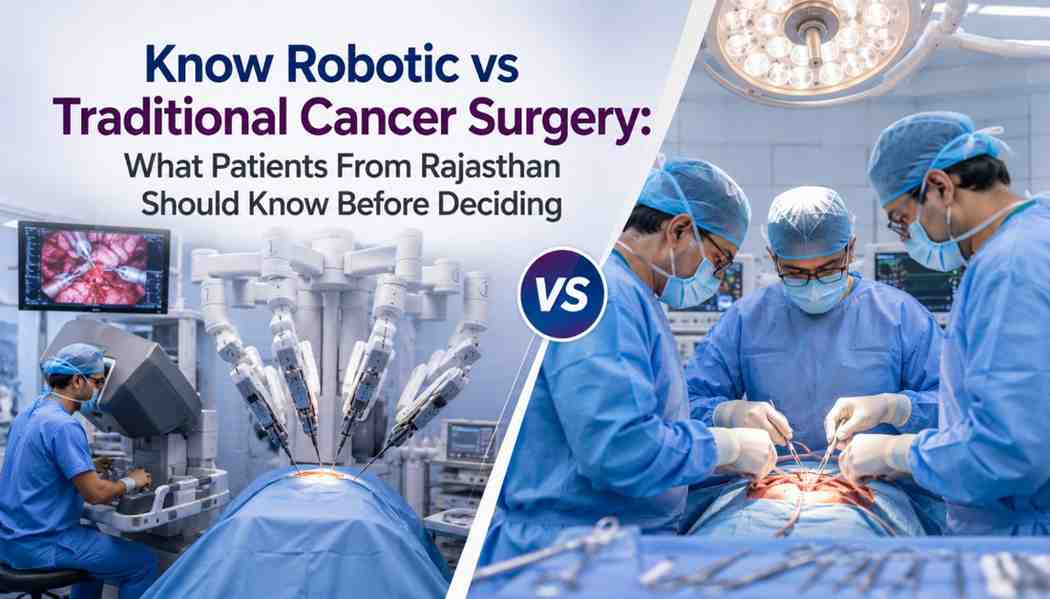
Traditional (open) cancer surgery involves a single, often larger incision that gives the surgeon direct hand access to the tumor and surrounding tissue. Robotic surgery, by contrast, uses several small incisions through which robotic arms — controlled in real time by the surgeon at a console — carry out the operation, aided by a magnified 3D camera view.
The surgeon is in control in both cases. The difference lies in how that control is exercised: directly by hand in open surgery, or through a robotic interface in robotic surgery.
What "Minimally Invasive" Actually Means
“Minimally invasive” doesn’t mean less thorough. It refers to the size and number of incisions used to access the surgical site, not the extent or completeness of the cancer removal. A minimally invasive procedure can be just as comprehensive as an open one when it’s clinically appropriate for the case.
Robotic Surgery Advantages
Commonly reported robotic surgery advantages include:
- Smaller incisions and generally less visible scarring
- Often reduced blood loss during the procedure
- Enhanced visualization through 3D magnification, useful in anatomically tight spaces
- Greater instrument range of motion than the human wrist allows
- Frequently shorter hospital stays
These are general patterns from surgical practice, not guarantees. Whether they apply to you depends on your specific case.
Open Surgery Recovery: What to Expect
Open surgery recovery typically involves:
- A longer initial hospital stay, often several days longer than with minimally invasive approaches
- A longer period before returning to normal activity, due to the larger incision and associated healing time
- Closer monitoring of the surgical wound during early recovery
- Physical therapy or mobility support in some cases, particularly for larger abdominal or thoracic procedures
Open surgery remains the necessary and correct choice for many patients — particularly when tumors are large, deeply invasive, or located in areas where minimally invasive access isn’t safe or technically feasible.
Is Robotic Surgery Better Than Open Surgery?
This is one of the most searched questions patients ask, and the honest answer is: it depends on the case, not on the technology itself.
When Robotic Surgery May Be Preferred
- Tumors that are accessible through small incisions without compromising the completeness of removal
- Cases where reduced blood loss and faster recovery would meaningfully benefit the patient’s overall health
- Anatomically complex areas where enhanced visualization and precision offer a real advantage
When Open Surgery May Still Be the Right Choice
- Larger or more extensive tumors requiring wider access
- Cases involving significant scar tissue from previous surgeries
- Situations where speed of access is critical, such as certain emergency presentations
- When the surgical team determines minimally invasive access would compromise oncological safety
Minimally Invasive vs Open: A Side-by-Side Comparison
Factor | Open Surgery | Robotic (Minimally Invasive) Surgery |
Incision | One larger incision | Several small incisions |
Blood loss | Generally higher | Generally lower |
Hospital stay | Typically longer | Often shorter |
Visible scarring | More prominent | Usually minimal |
Procedure time | Often shorter | Can be longer in some cases |
Suitability | Larger/complex tumors, certain emergencies | Anatomically accessible tumors, appropriate staging |
Cost | Generally lower | Generally higher due to technology |
Robotic Surgery Recovery Time Comparison
While individual recovery varies significantly by patient and procedure, general patterns reported in surgical practice show:
- Robotic surgery: Many patients return to light activity within days to a couple of weeks, with shorter hospital stays.
- Open surgery: Recovery to the same level of activity often takes longer, with an extended hospital stay and gradual increase in activity over several weeks.
These are general trends, not individual predictions. Your surgeon can give you a recovery estimate specific to your procedure and health status.
Which Surgery Has Fewer Complications?
Complication rates depend heavily on the specific procedure, the surgeon’s experience with that technique, and the patient’s overall health — there is no universal answer that applies to every cancer type. In general:
- Robotic and laparoscopic approaches are associated with lower rates of wound infection and blood loss in many procedures.
- Open surgery may carry a higher risk of wound-related complications due to the larger incision, though it may be the safer overall choice for certain complex or large tumors where thorough access matters more than incision size.
- Rarely, a robotic procedure needs to be converted to open surgery mid-operation if unexpected findings require it — this is a safety measure, not a failure of the technique.
The most reliable way to understand your personal complication risk is a direct conversation with your surgical oncologist about your specific case.
Factors That Determine Which Approach Is Right for You
- Tumor size, location, and stage
- Whether the cancer has spread to nearby structures
- Your overall fitness for surgery and anesthesia
- Prior abdominal or pelvic surgeries (which can affect minimally invasive access)
- Availability of robotic-trained surgical teams for your specific cancer type
- Your own priorities around recovery time, scarring, and cost
Common Myths About Robotic and Open Cancer Surgery
- “Robotic surgery is always the better choice.” False — clinical suitability determines the right approach, not general preference.
- “Open surgery is outdated.” False — it remains essential and often the safest option for many complex or large tumors.
- “Robotic surgery removes less tissue.” False — the extent of tissue removal is determined by oncological need, not the surgical technique.
“Faster recovery always means a better outcome.” Not necessarily — recovery speed and long-term cancer control are separate considerations, and both matter.
Expert Insights
When discussing surgical options with your care team, consider asking:
- Is my specific tumor suitable for a robotic approach, or does its size/location require open surgery?
- What is your team’s experience with this specific procedure, robotic or open?
- What complication rates are typical for this specific surgery, in either approach?
- How will the choice of approach affect my post-surgical treatment plan, such as chemotherapy or radiation timing?
- What would recovery realistically look like for me, given my age, health, and lifestyle?
A second opinion is a normal and reasonable step if you feel uncertain about which approach is being recommended for your case.
Key Takeaways
- Robotic and traditional (open) cancer surgery differ mainly in incision size, visualization, and instrument control — not in the surgeon’s decision-making authority.
- Robotic surgery advantages often include smaller incisions, reduced blood loss, and shorter hospital stays, but these are general trends, not guarantees.
- Open surgery recovery typically takes longer, but remains the necessary and correct choice for larger or more complex tumors.
- Neither approach is universally “better” — clinical suitability for your specific cancer determines the right choice.
- Complication rates vary by procedure and surgical team experience, not by technology alone.
A direct conversation with your surgical oncologist is the only reliable way to determine which approach fits your case.
Frequently Asked Questions (FAQs)
1. Is robotic surgery better than open surgery?
Neither is universally better — the right choice depends on your tumor’s size, location, stage, and your overall health.
2. What is the main difference between robotic and traditional cancer surgery?
Traditional surgery uses one larger incision with direct hand access, while robotic surgery uses several small incisions with the surgeon operating through a console-controlled system.
3. Does robotic surgery have a shorter recovery time?
Often yes, many patients experience a quicker return to light activity, though recovery still depends on the specific procedure and individual health.
4. Which surgery has fewer complications, robotic or open?
It varies by procedure; robotic approaches are often associated with lower wound-related complications, but open surgery may be safer for certain large or complex tumors.
5. Is robotic surgery more expensive than open surgery?
Generally, yes, due to the specialized technology and equipment involved.
6. Can every cancer patient choose robotic surgery?
No, suitability depends on tumor characteristics and overall health, determined through individual evaluation by a surgical oncologist.
7. Does robotic surgery remove cancer as thoroughly as open surgery?
Yes, when clinically appropriate, robotic surgery aims for the same oncological completeness as open surgery; the technique doesn’t change the extent of removal required.
8. What happens if a robotic surgery needs to be converted to open surgery?
This can occur if unexpected findings require it during the procedure and is done as a safety measure to ensure the operation is completed properly.
9. How do I know which approach my cancer requires?
Only a surgical oncologist can determine this after reviewing your imaging, staging, and overall health.
10. Is scarring less noticeable with robotic surgery?
Generally yes, since robotic surgery uses smaller incisions compared with the single larger incision used in open surgery.
11. Does choice of surgery affect further treatment like chemotherapy?
It can influence timing and recovery before starting additional treatments; this should be part of your overall treatment planning discussion.
12. Should I get a second opinion before deciding on a surgical approach?
Yes, seeking a second opinion is a reasonable and encouraged step, especially for a decision as significant as cancer surgery.
Conclusion
Choosing between robotic and traditional cancer surgery isn’t about picking the more modern-sounding option — it’s about matching the right technique to your specific diagnosis. Robotic surgery often offers smaller incisions and faster recovery, while open surgery remains essential and often safer for larger or more complex cases. The most important step isn’t researching the technology in isolation; it’s having a clear, honest conversation with a qualified surgical oncology team who can guide you toward the approach that’s genuinely right for your case.
Call-to-Action
If you’re trying to decide between robotic and traditional surgery for a cancer diagnosis, you don’t have to figure it out from articles alone. Book a consultation with the surgical oncology team at Zanish Rajasthan to get a clear, personalized assessment of which approach is appropriate for your specific case — and the compassionate guidance to help you move forward with confidence.
Other Posts
How Robotic Surgery Reduces Recovery Time After Cancer Treatment
Robotic Surgery Recovery Time: How It May Support Recovery After Cancer Treatment For patients undergoing cancer surgery, recovery is an...
What to Ask Before Choosing a Robotic Cancer Surgery Team
What to Ask Before Choosing a Robotic Cancer Surgery Team What Makes a Good Robotic Cancer Surgery Team? A strong...
Cost of Robotic Cancer Surgery: What Determines the Price
10 Early Signs of Colon Cancer You Should Never Ignore Introduction When cancer surgery is recommended, understanding the financial aspect...