
Precision and Blood Loss Reduction With Robotic Cancer Surgery
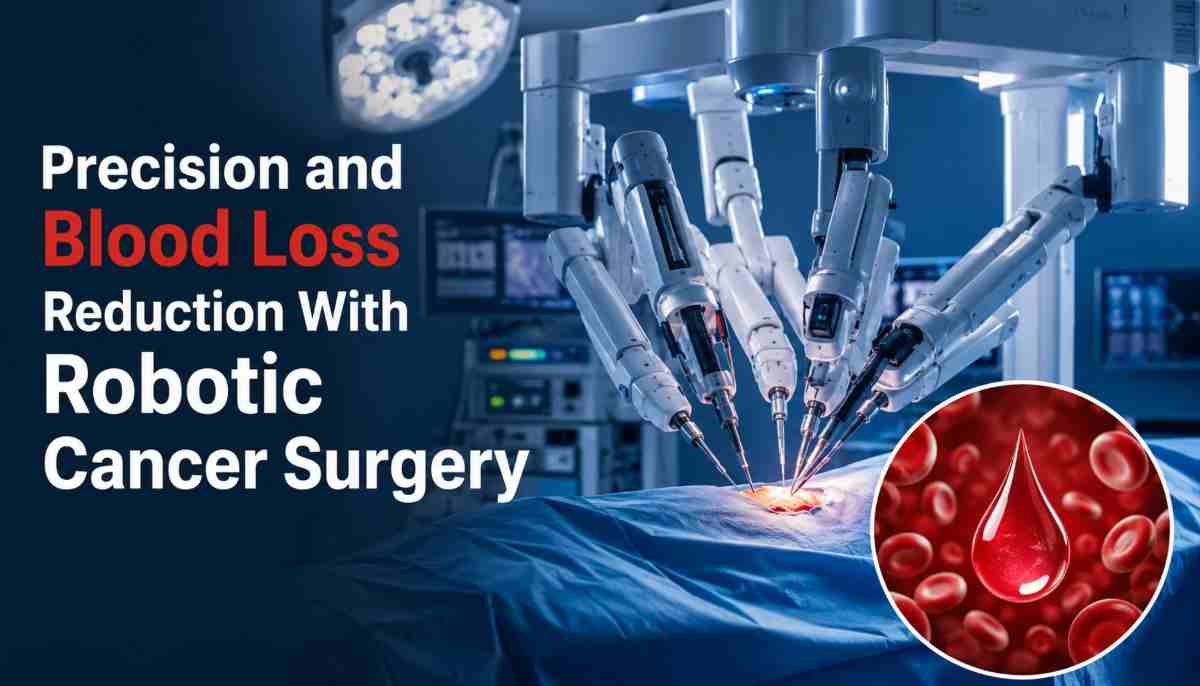
What Is Robotic Cancer Surgery?
Robotic cancer surgery is a type of minimally invasive surgery used for selected cancer procedures.
Instead of making one large incision, the surgeon generally operates through several smaller openings. A camera and specialised instruments are introduced through these openings. The surgeon controls the instruments from a console while viewing the surgical field on a high-resolution display.
The robotic system can provide:
- Magnified visualisation
- Three-dimensional depth perception in many systems
- Precise instrument movement
- Wristed instrument articulation
- Fine control in confined anatomical spaces
- Tremor filtration in robotic systems
The key point is important:
Robotic surgery is surgeon-controlled surgery. The robot assists the surgeon; it does not make independent decisions or remove the need for surgical expertise.
The National Cancer Institute describes robotic approaches as part of minimally invasive surgery, while the American Cancer Society notes that robotic systems may be used to assist laparoscopic or thoracoscopic cancer surgery.
How Can Robotic Surgery Reduce Blood Loss?
One of the potential advantages of robotic-assisted surgery is reduced intraoperative blood loss in appropriately selected procedures.
1. Smaller surgical access
Minimally invasive approaches use smaller incisions than traditional open surgery. This can reduce the amount of tissue disruption associated with surgical access.
2. Enhanced visualisation
The surgeon can work with an enlarged view of the operating field. This may make it easier to identify important anatomical structures and perform careful dissection.
3. Precise instrument movement
Robotic instruments are designed to reproduce fine movements within the body. Their articulation can be particularly useful when operating around delicate structures or in anatomically restricted spaces.
4. Controlled tissue dissection
Careful separation of tissues and identification of blood vessels can help surgeons control bleeding during appropriate procedures.
5. Potentially less tissue trauma
Because robotic surgery is generally performed through smaller access points, there may be less disruption of surrounding tissues compared with some open operations.
However, precision does not mean zero blood loss.
Bleeding remains a possible complication of any major operation, including robotic cancer surgery.
What Does the Evidence Say About Robotic Surgery Blood Loss?
Evidence varies according to the type of cancer and procedure.
A systematic review of randomised controlled trials involving cancer patients found that robot-assisted surgery was associated with lower estimated blood loss compared with open surgery, although the magnitude of benefit varied between cancers and procedures. The review also emphasised that robotic surgery did not necessarily improve long-term cancer outcomes across all settings.
A broader systematic review and meta-analysis covering robotic surgery across multiple procedures also found lower blood loss and transfusion rates compared with open surgery, while noting that results were less consistent when robotic surgery was compared with conventional minimally invasive surgery.
This distinction is important.
Robotic vs open surgery
The difference in blood loss can be meaningful in some operations.
Robotic vs laparoscopic surgery
The difference may be smaller because both techniques are already minimally invasive.
Therefore, patients should not assume:
Robotic = always less blood loss.
A more accurate statement is:
Robotic surgery can reduce blood loss in certain cancer procedures and appropriately selected patients, particularly when compared with open surgery, but the advantage depends on the operation and clinical circumstances.
Does Robotic Surgery Reduce the Need for Blood Transfusion?
It can, particularly when compared with open surgery, but it does not eliminate the possibility of transfusion.
A blood transfusion may become necessary if significant blood loss occurs or if the patient’s clinical condition requires it.
Studies of specific cancer operations have reported lower transfusion rates with robotic approaches.
For example, a meta-analysis of robot-assisted radical prostatectomy found lower blood loss and lower transfusion rates compared with open radical prostatectomy.
Similarly, research comparing intracorporeal robotic radical cystectomy with open surgery found significantly lower estimated blood loss and lower blood transfusion rates with the robotic approach.
However, these findings should not be interpreted as a promise that an individual patient will not need blood.
Factors affecting transfusion need include:
- Preoperative haemoglobin level
- Existing anaemia
- Cancer type
- Tumour size and location
- Extent of surgery
- Blood vessel involvement
- Previous surgery or radiation
- Intraoperative bleeding
- Patient’s overall health
- The hospital’s blood-management protocols
Your surgical team should assess these factors before surgery.
Why Precision Matters in Cancer Surgery
Cancer surgery is different from simply removing a visible mass.
Depending on the cancer, surgery may involve removing:
- The primary tumour
- Surrounding tissue
- Nearby lymph nodes
- Involved organs or structures
- Tissue required to achieve an appropriate surgical margin
The surgeon must balance two goals:
Remove the cancer adequately while preserving as much healthy and functional tissue as safely possible.
This is where precision can matter.
For example, some cancers develop close to nerves, blood vessels, the urinary system, bowel or other important structures. A magnified view and articulated instruments may help the surgeon perform detailed dissection in selected anatomical locations.
The American Cancer Society notes that robotic systems may allow precise surgical movements through small incisions, while the NCI explains that robotic surgery is one form of minimally invasive cancer surgery.
However, technology cannot substitute for appropriate cancer treatment planning or surgical judgement.
The choice of surgical technique should be based on the cancer, its stage and location, the patient’s health, the goals of treatment and the expertise available.
Robotic Surgery Complications: What Patients Should Know
Robotic surgery is not risk-free.
Like other major operations, it can involve complications such as:
- Bleeding
- Infection
- Blood clots
- Injury to nearby organs or structures
- Anaesthetic complications
- Urinary or bowel problems, depending on the procedure
- Conversion to open surgery when necessary
- Need for additional treatment or intervention
The exact risks depend heavily on the type of cancer and operation.
For example, complex cancer operations involving the abdomen, pelvis, chest or other anatomically challenging areas can have very different risk profiles.
Does robotic surgery have fewer complications?
Sometimes, but not universally.
A recent systematic review of randomised controlled trials found some short-term advantages for robot-assisted surgery compared with open surgery, including lower estimated blood loss and a modest reduction in overall complications. However, the researchers noted that outcomes varied across cancer types and that evidence did not demonstrate universal advantages in long-term oncological outcomes.
That is why searching for a single robotic surgery complication rate can be misleading.
A meaningful risk discussion should be specific to:
Your cancer + your operation + your health + your surgical team.
Robotic Surgery and Hospital Stay
Blood loss is only one part of postoperative recovery.
Hospital stay can also be influenced by:
- Surgical trauma
- Pain
- Bowel recovery
- Mobility
- Nutrition
- Urinary function
- Wound healing
- Complications
- The type and complexity of cancer surgery
Because robotic surgery is generally minimally invasive, some patients may have a shorter hospital stay compared with open surgery.
The NCI states that minimally invasive cancer surgery generally involves smaller incisions and can require less recovery time than open surgery.
Evidence also supports shorter hospitalisation in some specific robotic cancer procedures. For example, comparative evidence in prostate cancer surgery has found shorter hospitalisation with robotic or laparoscopic approaches compared with open surgery.
But robotic surgery hospital stay is not fixed.
A patient should never choose a surgical approach based solely on the expected number of hospital days.
Does Robotic Surgery Mean Smaller Scars?
Usually, robotic surgery involves several small incisions rather than one larger incision.
This can result in:
- Smaller individual wounds
- Less extensive surgical access
- Reduced visible scarring compared with some open operations
The NCI notes that minimally invasive surgery uses small incisions and may cause less pain and scarring than traditional surgery.
However, scar size and appearance vary according to:
- Number of incisions
- Location of the incisions
- Type of procedure
- Need to remove the tumour
- Patient healing
- Skin characteristics
- Wound complications
So, the answer to “What is the robotic surgery scar size?” is not a single measurement.
Your surgeon can explain the likely incision locations and expected wound pattern for your specific operation.
Robotic Surgery vs Open Surgery: What Patients Should Understand
Factor | Robotic / Minimally Invasive Surgery | Open Surgery |
Surgical access | Several smaller incisions | Usually one larger incision |
Visualisation | Magnified camera-based view | Direct surgical view |
Blood loss | May be lower in selected procedures | May be higher in some procedures |
Blood transfusion | May be less frequent in selected procedures | Can be more likely in some major operations |
Hospital stay | Often shorter in selected procedures | Can be longer depending on operation |
Scarring | Usually smaller individual scars | Usually larger incision |
Recovery | May be faster for appropriate procedures | Can require longer recovery |
Suitability | Depends on cancer and patient | May be preferred or necessary for some cancers |
Operative time | Can sometimes be longer | Depends on procedure |
Cancer control | Must remain the primary objective | Must remain the primary objective |
Evidence supports potential short-term benefits of robotic approaches in selected operations, but the comparison should always be procedure-specific.
Key Takeaways
- Robotic surgery blood loss may be lower than open surgery in several cancer procedures.
- Reduced blood loss may contribute to lower transfusion requirements in selected patients.
- Robotic surgery provides the surgeon with specialized instruments and enhanced visualization but does not operate independently.
- Smaller incisions may contribute to less tissue trauma, smaller scars and faster recovery.
- Robotic surgery does not eliminate surgical complications.
- Hospital stay varies according to the operation, patient health and recovery.
- Robotic surgery is not appropriate for every cancer.
- The surgeon’s experience with the specific cancer procedure
- Cancer control and patient safety should remain the primary priorities.
- Patients should discuss their individual risks and expected benefits with a qualified cancer surgery team.
Frequently Asked Questions (FAQs)
Does robotic surgery reduce blood loss?
It can. Studies of several cancer procedures have found lower blood loss with robotic surgery compared with open surgery. However, the benefit varies by cancer type, procedure and patient.
Does robotic surgery reduce the need for blood transfusion?
In some cancer operations, robotic surgery is associated with lower transfusion rates than open surgery. However, transfusion may still be necessary if significant bleeding occurs or if a patient’s medical condition requires it.
Does robotic surgery have fewer complications?
It may have fewer short-term complications than open surgery in some procedures, but this is not universal. The risks depend on the cancer, operation, patient and surgical team.
Does robotic surgery mean smaller scars?
Generally, yes. Robotic surgery usually uses several small incisions rather than one large incision. The final appearance of scars varies between patients and procedures.
Does robotic surgery reduce hospital stay?
It can. Some robotic cancer procedures are associated with shorter hospital stays than open surgery. However, the expected stay depends on the operation and the patient’s recovery.
Conclusion
For patients considering cancer surgery, blood loss is an important part of the overall surgical risk—but it is only one part.
Robotic-assisted surgery can offer the advantages of minimally invasive surgery in appropriately selected cancer procedures. Research has demonstrated lower blood loss and, in some settings, fewer transfusions and shorter hospital stays compared with open surgery.
At the same time, robotic surgery is not automatically the best choice for every cancer. The complexity of the tumour, the patient’s health, the procedure being performed and the experience of the surgical team all influence outcomes.
The most useful question is therefore not simply:
“Is robotic surgery better?”
It is:
“Is robotic surgery the safest and most appropriate approach for my particular cancer and treatment goals?”
A detailed discussion with a qualified cancer surgery team can help you understand the expected benefits, risks, blood-loss considerations, recovery and alternatives before making a treatment decision.
Discuss Your Cancer Surgery Options With Zanish Rajasthan
Choosing a cancer surgery approach is an important decision. If you are considering robotic cancer surgery, a specialist consultation can help you understand whether a minimally invasive approach is appropriate for your diagnosis and what to expect before, during and after treatment.
At Zanish Rajasthan, patients can discuss their diagnosis, surgical options, potential risks and expected recovery with an appropriately qualified cancer care team.
Other Posts
Precision and Blood Loss Reduction With Robotic Cancer Surgery
Precision and Blood Loss Reduction With Robotic Cancer Surgery What Is Robotic Cancer Surgery? Robotic cancer surgery is a type...

Is Robotic Surgery Safe for Older Cancer Patients?
Is Robotic Surgery Safe for Older Cancer Patients? Robotic-assisted surgery is a form of minimally invasive surgery in which the...

How Robotic Surgery Reduces Recovery Time After Cancer Treatment
Robotic Surgery Recovery Time: How It May Support Recovery After Cancer Treatment For patients undergoing cancer surgery, recovery is an...