
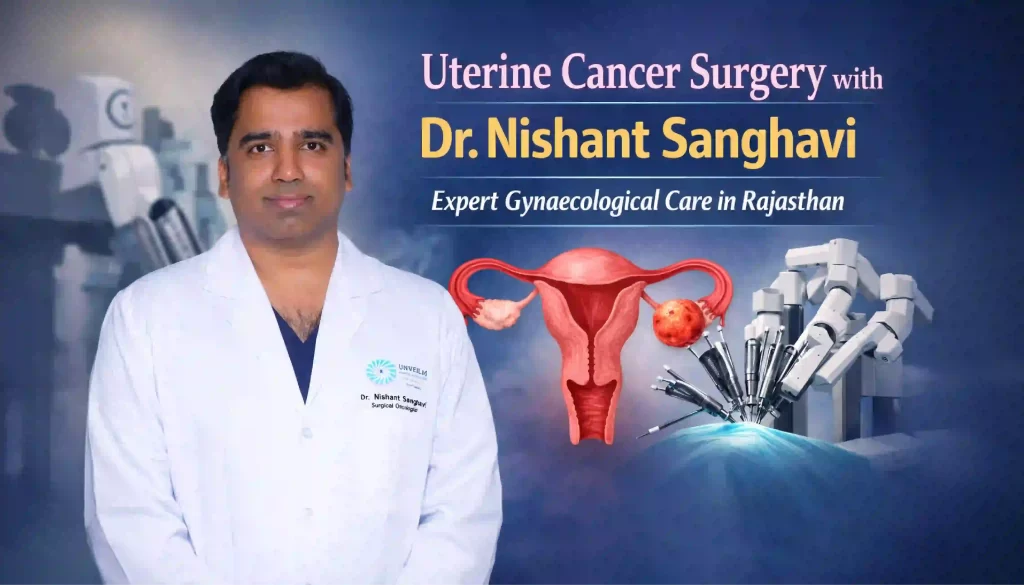
Uterine Cancer Surgery with Dr. Nishant Sanghavi: Expert Gynaecological Care in Rajasthan
Introduction
Uterine cancer — also called endometrial cancer — is one of the most common gynaecological cancers affecting women in India, and its incidence among women in Rajasthan continues to rise. Despite this, many women across the state delay seeking specialist care due to limited awareness, social hesitation around gynaecological symptoms, or uncertainty about where to find expert treatment close to home. Uterine cancer surgery in Rajasthan, when performed by a trained surgical oncologist at the right stage of the disease, offers women a strong chance of effective treatment and recovery. At Zanish Cancer Hospital, dedicated gynaecological oncology surgical care is available to women from across the state.
Understanding Uterine Cancer
Uterine cancer develops in the lining of the uterus — a tissue called the endometrium — when cells in that lining begin to grow abnormally. It most commonly affects women after menopause, though it can occur in younger women as well, particularly those with hormonal imbalances, obesity, diabetes, or a family history of Lynch syndrome or endometrial cancer.
The most important early warning sign is abnormal uterine bleeding — particularly any vaginal bleeding after menopause, or unusually heavy or irregular periods in premenopausal women. Other symptoms may include pelvic pain or discomfort and, in more advanced stages, unintended weight loss and fatigue.
Because abnormal bleeding is a relatively early and noticeable symptom, uterine cancer is frequently detected at an earlier stage than many other cancers — which is one reason why timely evaluation is so important. Early-stage endometrial cancer responds well to surgical treatment.
Why Timely Care Is Critical for Rajasthan Patients
In many parts of Rajasthan, abnormal bleeding is normalized or attributed to hormonal changes, and women — particularly in rural and semi-urban areas — may wait months before seeking medical attention. Cultural factors, limited awareness, and the absence of a nearby gynaecological oncology specialist all contribute to delayed presentation.
When uterine cancer is detected and treated at Stage I — confined to the uterus — surgical outcomes are significantly more favourable than at later stages where the cancer has spread to surrounding tissues, lymph nodes, or distant organs. Reducing the gap between symptom onset and specialist consultation is one of the most impactful steps in improving outcomes for women across Rajasthan.
Treatment Approach at Zanish Cancer Hospital
The primary treatment for uterine cancer is surgical removal of the uterus — a procedure called hysterectomy. Depending on the stage and type of cancer, this may include removal of the fallopian tubes and ovaries (salpingo-oophorectomy) and dissection of pelvic and para-aortic lymph nodes to assess for cancer spread.
At Zanish Cancer Hospital, the surgical approach is determined through a multidisciplinary tumor board review involving surgical oncologists, medical oncologists, radiation oncologists, radiologists, and pathologists. This collective evaluation ensures that each patient’s treatment plan is tailored to her specific cancer stage, histological type, and overall health — rather than following a one-size-fits-all protocol.
Where clinically suitable, minimally invasive laparoscopic hysterectomy is offered, which allows for smaller incisions, reduced post-operative pain, shorter hospital stay, and a faster return to daily activity. In more complex or advanced cases, open surgery remains the appropriate choice and is performed with the same standard of oncological precision.
For patients with higher-risk or advanced-stage uterine cancers, surgery is coordinated with adjuvant radiation therapy or chemotherapy to reduce the risk of recurrence — all managed within the hospital’s multidisciplinary framework.
Clinical Expertise and Leadership
Gynaecological oncology surgery at Zanish Cancer Hospital is supported by the surgical oncology leadership of Dr. Nishant Sanghavi, who holds an MCh in Surgical Oncology from the Gujarat Cancer and Research Institute (GCRI), Ahmedabad, and has completed fellowship training in Advanced Laparoscopic Oncosurgery. His expertise across pelvic oncology surgery — including uterine, ovarian, and cervical cancer procedures — brings a level of specialist surgical depth to Rajasthan patients that was previously accessible only in major metropolitan centres.
Dr. Sanghavi’s approach to gynaecological cancer surgery prioritizes complete oncological clearance while being mindful of each patient’s physical recovery, emotional well-being, and quality of life following treatment.
The Patient Care Journey
Women presenting to Zanish Cancer Hospital for uterine cancer evaluation and treatment follow a well-defined care pathway:
- Consultation: Detailed symptom review, gynaecological history, and assessment of risk factors
- Diagnosis: Transvaginal ultrasound, endometrial biopsy for histological confirmation, MRI pelvis for local staging, and CT scan to assess for distant spread
- Staging and Planning: Tumor board discussion to determine surgical approach and need for adjuvant treatment
- Surgery: Hysterectomy with or without lymph node dissection, performed using laparoscopic or open technique based on clinical assessment
- Recovery: Post-operative inpatient monitoring, pain management, and discharge planning with clear activity guidance
- Follow-Up: Scheduled review visits, pathology discussion, and monitoring for recurrence through imaging and clinical examination
Throughout this journey, patients and their families are kept fully informed — with findings, options, and expected outcomes explained in straightforward, accessible terms.
Why Rajasthan Patients Choose Zanish Cancer Hospital
Women from Jaipur, Jodhpur, Ajmer, Bikaner, Kota, Udaipur, and smaller towns across Rajasthan choose Zanish Cancer Hospital for uterine cancer surgery because the hospital offers specialist gynaecological oncology care within the state — without requiring travel to distant cities. The team’s honest, patient-first approach means women are never rushed through a consultation or left uncertain about what their diagnosis means or what their treatment will involve.
The hospital also recognises the emotional dimension of gynaecological cancer surgery — particularly for younger women or those with concerns about the implications of hysterectomy — and the team takes time to address these concerns with sensitivity and clinical clarity.
FAQs
What are the early signs of uterine cancer that women in Rajasthan should not ignore?
Any vaginal bleeding after menopause, or persistent abnormal bleeding in premenopausal women, should be evaluated by a specialist without delay. These are the most common and early presenting symptoms of uterine cancer.
Is laparoscopic hysterectomy available for uterine cancer surgery at Zanish Cancer Hospital in Rajasthan?
Yes. Minimally invasive laparoscopic hysterectomy is available for suitable cases, offering a faster recovery and shorter hospital stay compared to open surgery.
Will I need radiation or chemotherapy after uterine cancer surgery?
It depends on the cancer stage, histological grade, and pathological findings after surgery. Higher-risk cases may require adjuvant radiation or chemotherapy — this is assessed and planned through the tumor board process.
Can younger women with uterine cancer preserve fertility during treatment?
In very early, low-grade cases, fertility-sparing approaches may sometimes be discussed. However, standard treatment for uterine cancer involves hysterectomy. A specialist consultation is essential to assess individual eligibility and options.
How long is the recovery after uterine cancer surgery?
Recovery varies by surgical approach. Laparoscopic surgery typically allows discharge within two to three days, with a return to light activity within two to four weeks. Open surgery may require a longer inpatient stay and recovery period.
Conclusion
Uterine cancer is a condition where early detection and specialist surgical care make a genuine difference to outcomes. Women across Rajasthan deserve access to expert gynaecological oncology surgery close to home — and at Zanish Cancer Hospital, that care is available. If you or someone you care for is experiencing abnormal uterine bleeding or has received a uterine cancer diagnosis, reaching out for a specialist consultation is the most important step you can take.
Disclaimer: This article is for informational purposes only and does not constitute medical advice. Please consult a qualified oncologist for a personalised evaluation and treatment plan specific to your condition.
Other Posts
Is Robotic Surgery Safe for Older Cancer Patients?
Is Robotic Surgery Safe for Older Cancer Patients? Robotic-assisted surgery is a form of minimally invasive surgery in which the...
How Robotic Surgery Reduces Recovery Time After Cancer Treatment
Robotic Surgery Recovery Time: How It May Support Recovery After Cancer Treatment For patients undergoing cancer surgery, recovery is an...
What to Ask Before Choosing a Robotic Cancer Surgery Team
What to Ask Before Choosing a Robotic Cancer Surgery Team What Makes a Good Robotic Cancer Surgery Team? A strong...