
Gallbladder Cancer Surgery in Jaipur: When Is Surgery the Right Option and Who Should Perform It?
Introduction
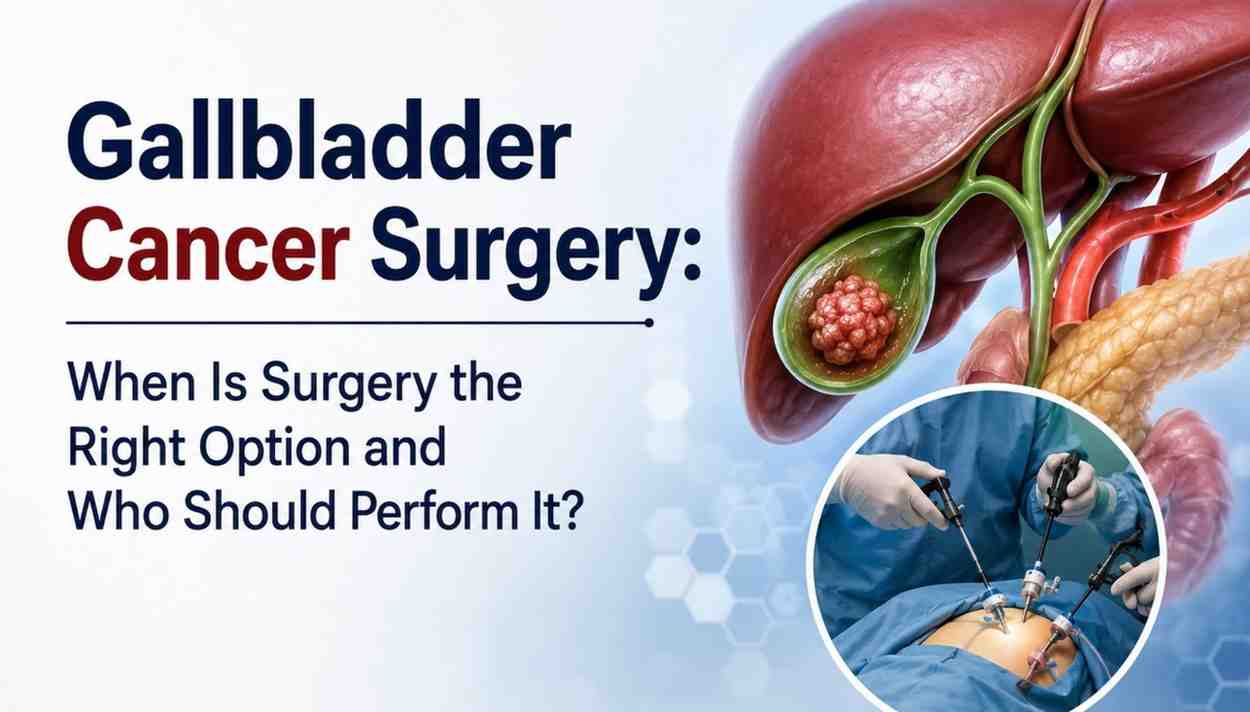
Gallbladder cancer is one of the most common gastrointestinal cancers in northern India — and Rajasthan carries one of the highest incidence rates in the country. Yet despite this, many patients and families remain uncertain about what treatment involves, when surgery is appropriate, and where to find a specialist. If you are looking for information about gallbladder cancer surgery in Jaipur, this article will help you understand your options, what determines surgical eligibility, and why the experience of the treating surgeon matters significantly in this cancer.
Understanding Gallbladder Cancer and Surgical Treatment
The gallbladder is a small organ beneath the liver that stores bile. Gallbladder cancer develops when malignant cells form in the gallbladder wall. It is often diagnosed late because early-stage disease rarely causes distinct symptoms — many cases are discovered incidentally during routine cholecystectomy (gallbladder removal) for gallstones.
Surgery is the only potentially curative treatment for gallbladder cancer. The type of surgery depends on the stage:
- Simple cholecystectomy — removal of the gallbladder alone, appropriate only for very early-stage (T1a) disease
- Extended (radical) cholecystectomy — removal of the gallbladder along with a margin of liver tissue and regional lymph nodes; recommended for T1b and T2 stage cancers
- More extensive resection — in selected T3 cases, surgery may include removal of additional liver segments or bile duct reconstruction
For advanced or metastatic disease, surgery is generally not curative, and treatment focuses on systemic therapy and quality-of-life management. A specialist assessment is essential to determine which category applies to each patient.
Why Early Detection Is Critical in Rajasthan
Rajasthan has a disproportionately high burden of gallbladder cancer, likely linked to the prevalence of gallstone disease in the region. Despite this, many patients are diagnosed at advanced stages — partly due to limited awareness of symptoms such as upper abdominal pain, jaundice, nausea, or unexplained weight loss, and partly due to delayed referrals to specialist oncology centres.
The surgical window for gallbladder cancer is narrow. Tumours that are resectable at stage T2 may become inoperable within months if diagnosis or specialist referral is delayed. For patients across Rajasthan — whether in Jaipur, Ajmer, Alwar, or smaller districts — prompt evaluation by a gallbladder oncology surgeon in Rajasthan following any suspicious finding is strongly advisable.
Treatment Approach at Zanish Cancer Hospital
At Zanish Cancer Hospital, gallbladder cancer cases are reviewed by a multidisciplinary oncology team that includes surgical oncologists, medical oncologists, interventional radiologists, and hepatobiliary specialists. This team-based review ensures that every surgical recommendation is backed by thorough staging and collective clinical judgement.
Treatment pathways considered include:
- Surgical resection — for resectable early to intermediate stage disease
- Neoadjuvant or adjuvant chemotherapy — before or after surgery where indicated to reduce recurrence risk
- Palliative biliary drainage — to relieve jaundice caused by bile duct obstruction in inoperable cases
- Systemic therapy — for advanced or metastatic gallbladder cancer
Every patient receives a clear, honest assessment of whether surgery is appropriate — including cases where it is not.
Clinical Expertise and Leadership
Gallbladder cancer surgery — particularly radical cholecystectomy with liver resection and lymphadenectomy — requires specialised hepatobiliary surgical expertise. Outcomes are directly linked to the experience of the operating surgeon and the centre’s volume of such procedures. Dr. Nishant Sanghavi, Surgical Oncologist at Zanish Cancer Hospital, brings focused experience in GI and hepatobiliary oncology surgeries. For families asking “who is the best surgeon for gallbladder cancer in Jaipur?” — a formal consultation where your staging scans and pathology are reviewed is the most meaningful first step toward a reliable answer.
The Patient Care Journey
- Consultation — Symptoms, imaging reports, and prior surgical history reviewed by a specialist
- Diagnosis and Staging — Ultrasound, CT scan, MRI, and biopsy where indicated to confirm diagnosis and assess resectability
- MDT Review — Surgical team and oncologists collectively determine operability and treatment plan
- Surgery — Cholecystectomy or extended resection performed with appropriate hepatobiliary surgical protocols
- Recovery — Hospital stay of 3–7 days depending on extent of surgery; gradual return to normal diet and activity over 4–6 weeks
- Follow-Up — Adjuvant chemotherapy if indicated, regular imaging surveillance, and long-term monitoring for recurrence
Why Rajasthan Patients Choose Zanish Cancer Hospital
- Specialist GI and hepatobiliary oncology expertise — not general surgery adapted for cancer cases
- MDT-based operability assessment for every gallbladder cancer case
- Honest staging discussions — patients are told clearly whether surgery is curative, palliative, or not indicated
- Accessible specialist oncology care in Jaipur for patients from across Rajasthan
- Integrated post-surgical support including adjuvant therapy planning and follow-up
Frequently Asked Questions (FAQs)
Q1. When is gallbladder cancer surgery recommended?
Surgery is recommended when the cancer is confined to the gallbladder or has limited local spread (typically T1 to selected T3 stages), the patient is fit enough to tolerate the procedure, and there is no distant metastasis. A specialist review of your staging investigations is required to determine eligibility.
Q2. Can gallbladder cancer be cured with surgery in Rajasthan?
In early to intermediate stage cases where complete surgical resection is achievable, surgery offers the best chance of long-term disease control. Outcomes depend significantly on the stage at diagnosis and the completeness of resection. There are no universal cure guarantees — your oncologist will give you a realistic prognosis based on your specific case.
Q3. Who is the best surgeon for gallbladder cancer in Jaipur?
The most important factor is finding a surgical oncologist with specific hepatobiliary and GI oncology experience — not a general surgeon. Zanish Cancer Hospital offers specialist gallbladder cancer surgical services in Jaipur. A formal consultation with review of your imaging is the right starting point.
Q4. What happens if gallbladder cancer is found incidentally after routine cholecystectomy?
If gallbladder cancer is found unexpectedly in a routine specimen, re-staging investigations are needed to determine the depth of tumour invasion. Depending on the stage (T1b or higher), a second surgery — radical re-resection — may be recommended. This decision should be made by a surgical oncologist, not a general surgeon.
Q5. What is the difference between simple and radical cholecystectomy for gallbladder cancer?
Simple cholecystectomy removes only the gallbladder and is sufficient for very early-stage (T1a) disease. Radical cholecystectomy additionally removes a margin of liver tissue and regional lymph nodes, and is required for T1b and T2 cancers to achieve adequate oncological clearance. Your surgeon will explain which is appropriate for your stage.
Conclusion
Gallbladder cancer requires prompt, specialist evaluation — particularly in Rajasthan, where incidence is high but access to dedicated oncology surgical expertise has historically been limited. Whether surgery is the right option for you depends on staging, fitness, and the experience of the centre treating you.
At Zanish Cancer Hospital, we provide every patient with a transparent, evidence-based assessment of their surgical options — and honest answers when surgery is not the right path. If you or a loved one has been diagnosed with gallbladder cancer and wants to understand whether surgery is appropriate, we encourage you to consult with our oncology team without delay.
Other Posts
Advanced Cancer Surgery in Rajasthan: What Technologies Does Zanish Cancer Hospital Use?
Advanced Cancer Surgery in Rajasthan: What Technologies Does Zanish Cancer Hospital Use? Introduction When a cancer diagnosis requires surgery, patients...
Gallbladder Cancer Surgery in Jaipur: When Is Surgery the Right Option and Who Should Perform It?
Gallbladder Cancer Surgery in Jaipur: When Is Surgery the Right Option and Who Should Perform It? Introduction Gallbladder cancer is...
Robotic Surgery for Gynaecological Cancer in Jaipur: Benefits, Risks, and Recovery Compared
Robotic Surgery for Gynaecological Cancer in Jaipur: Benefits, Risks, and Recovery Compared Introduction As surgical technology advances, more women diagnosed...